Water Heater Repair in Great Kills, Staten Island
Trusted water heater repair Great Kills Staten Island homeowners rely on when facing cold showers, leaking storage tanks, or pilot burner lockouts. We service atmospheric gas water heaters, electric multi-element units, power-vent systems, and indirect water tanks connected to central boilers.
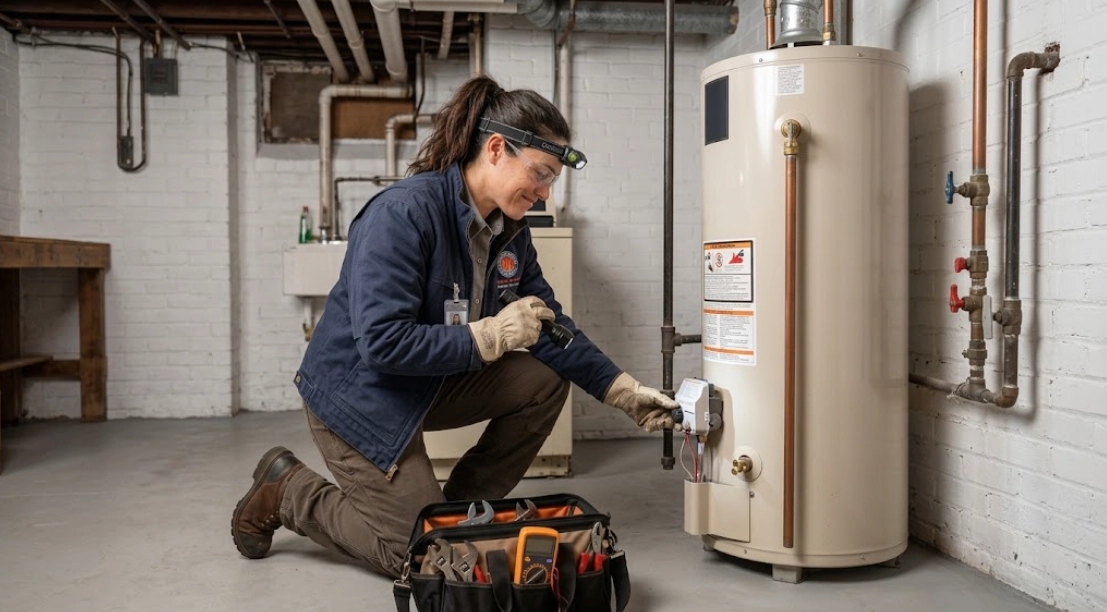
Signs Your Water Heater Requires Immediate Service
Domestic water heater failures range from simple sensor replacements to severe structural leaks that can flood finished basements.
Completely Cold Water
In gas water heaters, cold water often stems from a tripped thermal switch, an extinguished pilot flame, or a defective millivolt thermocouple. In electric units, it points to a tripped high-limit reset button or burned-out heating elements.
Water Pooling Beneath Tank
Moisture pooling on the basement floor requires immediate distinction between external leaks (such as a dripping temperature and pressure relief valve or dielectric union) and permanent internal steel tank corrosion.
Popping Sounds & Rusty Water
Rumbling, popping, or boiling noises indicate that heavy calcium and mineral sediment has formed a hard crust at the bottom of the tank, trapping water pockets that overheat and vaporize violently.
Equipment Configurations in Great Kills Homes
Staten Island properties utilize several distinct domestic water heating configurations depending on fuel source and heating plant design.
Gas vs. Electric Water Heaters
Most homes along Amboy Road and Arthur Kill Road utilize natural gas water heaters venting into a shared masonry chimney alongside the central heating boiler. Atmospheric units depend on natural draft; any chimney blockage can cause carbon monoxide spillage.
Electric water heaters are common in home additions and spaces lacking chimney flues. These units rely on upper and lower 4500W heating elements governed by dual thermostats. We test resistance (ohms), voltage, and continuity to isolate electrical failures safely.
Indirect Water Heaters Connected to Boilers
Many Great Kills residences utilize an indirect water heater powered by their central hydronic or steam boiler. In this configuration, boiler water circulates through an internal stainless steel coil inside a separate well-insulated storage tank.
If an indirect water heater stops producing hot water, the fault may lie in the boiler's zone circulator pump, flow check valve, or aquastat rather than the tank itself. We coordinate diagnostics across both heating and domestic loops seamlessly.
Repair vs. Replacement Decision Guide
We guide homeowners through transparent mechanical choices:
- Sensible Repairs: Replacing dripping T&P safety relief valves, replacing thermocouples or electronic gas control valves, replacing electric elements and thermostats, or clearing drain spigots on tanks under 8 to 10 years old.
- Necessary Replacement: When the internal glass-lined steel vessel ruptures and leaks through the outer sheet metal jacket, repair is impossible due to constant 40–60+ PSI municipal pressure. Ruptured tanks must be replaced.
If your home's central heating system is also experiencing seasonal breakdowns, evaluate our complete boiler replacement services.
Our Diagnostic & Safety Protocol
Working with high-pressure heated water, natural gas, and 240V electricity requires strict adherence to safety standards.
- Supply Pressure & Thermal Expansion Check: Testing municipal incoming water pressure and checking thermal expansion tank bladder health to prevent premature tank rupture.
- Temperature & Pressure (T&P) Valve Testing: Verifying that the 150 PSI / 210°F safety relief valve operates smoothly and discharges through an unobstructed copper drop pipe.
- Combustion & Venting Evaluation: Inspecting gas burner orifices, checking draft hood clearance, and verifying chimney flue draw using carbon monoxide detection equipment.
- Sediment Flushing & Anode Inspection: Assessing sacrificial magnesium or aluminum anode rods that protect tank steel from electrolytic corrosion.
What to Do in a Water Heater Emergency
If you experience an active water heater flood in your Great Kills basement:
- Shut Off Cold Water: Locate the brass gate or ball valve on the cold water pipe directly above the heater and turn it clockwise until fully closed.
- De-Energize the Unit: For electric heaters, switch off the dedicated double-pole 30A circuit breaker. For gas heaters, rotate the front control knob to OFF.
- Call for Dispatch: Contact our team immediately at (315) 202-8009. If basement ground water is accumulating, inspect our sump pump flood protection systems.
Need fast, professional water heater diagnostics in Great Kills?
Call (315) 202-8009 to ScheduleFrequently Asked Questions About Water Heater Repair
Important questions regarding domestic hot water systems in Staten Island homes.
What immediate steps should I take if my water heater is actively leaking?
First, ensure your personal safety and avoid stepping into standing water near electrical connections. If safe to reach, turn the cold water shutoff valve on top of the tank clockwise to stop incoming water. For electric units, turn off the breaker at your electrical panel; for gas units, turn the temperature control dial to VACATION or OFF. Then call our dispatch at (315) 202-8009.
Can a leaking water heater storage tank be repaired or welded?
No. When an internal glass-lined steel tank corrodes through and water seeps from the jacket seams or base, it cannot be safely or reliably welded due to continuous municipal water pressure (40 to 60+ PSI). Ruptured tanks require replacement, whereas leaking temperature-and-pressure relief valves, drain spigots, or heating element gaskets can be repaired.
Why does my hot water run out much quicker than it used to?
Sudden loss of hot water capacity usually stems from severe mineral sediment accumulation displacing water volume at the bottom of the tank, a broken plastic dip tube allowing incoming cold water to short-circuit directly to the hot outlet, or a failed lower heating element in an electric water heater.
What is an indirect water heater and how does it connect to a boiler?
An indirect water heater does not have its own gas burner or electric heating elements. Instead, hot water circulated from your home's central heating boiler flows through an internal closed coil inside the water heater tank, transferring heat to your domestic water supply highly efficiently.
Explore Full Mechanical & Heating Services
Visit our boiler repair in Great Kills homepage, read about radiator steam heat repairs, check certified gas line services, or review our neighborhood coverage on the Service Areas page.