Steam Heat & Radiator Repair in Great Kills, Staten Island
Precision radiator repair Great Kills Staten Island homeowners count on to eliminate violent water hammer banging, replace leaking radiator valves, and restore balanced comfort across every room. We specialize in vintage cast-iron steam radiators and modern hydronic baseboard loops.
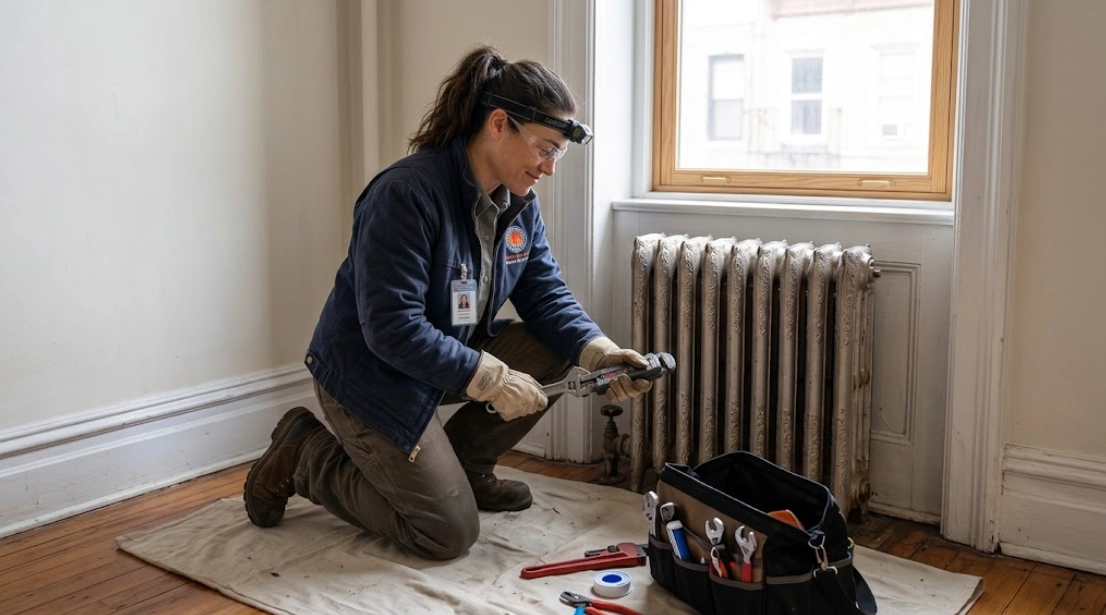
Common Radiator Symptoms & Warning Signs
When steam radiators fail to heat evenly or leak onto hardwood floors, understanding the mechanical cause is essential to preventing costly water damage.
Violent Banging & Water Hammer
Loud, metallic clanging occurs when oncoming steam hits pooled condensate inside an unpitched radiator or sagging horizontal branch line. The steam collapses into water pockets at high speed, creating destructive hydraulic shockwaves.
Spitting Air Vents & Valve Leaks
Air vents that spray rusty water onto baseboards, hissing vents that refuse to shut when steam arrives, or water weeping from radiator shutoff packing nuts. If left uncorrected, these leaks rot subfloors and damage ceilings below.
Completely Cold Radiators
When a radiator stays stone-cold while the rest of the house is warm, the cause is typically an air vent stuck shut with mineral scale, a disconnected internal valve disc, or trapped condensate air-locking the cast iron.
The Mechanics of Single-Pipe Steam Systems
Historic residences throughout Great Kills and neighboring South Shore communities frequently operate on single-pipe low-pressure steam heat.
Counter-Flow Dynamics: Steam vs. Condensate
In a single-pipe steam setup, a single pipe serves as both the steam supply and the condensate return. Steam expands up from the basement boiler, pushes atmospheric air out through the radiator vent, fills the cast-iron radiator, condenses into water upon giving up its heat, and drains back down the same pipe by gravity.
For this counter-flow system to work smoothly without noise, two rules are critical:
- Continuous Slope: The radiator must be pitched with a subtle downward slope toward the supply valve (approximately 1/4 inch per foot) so water never collects in the far sections.
- Fully Open Valves: The angle supply valve must remain 100% open. Throttling a steam valve partially closed restricts the return channel, trapping water and causing instant hammering.
Radiator Valve Replacement & Upgrades
Over decades of operation, brass radiator angle valves seize, packing seals dry out, and handle stems leak. Forcing an old frozen valve can snap brittle iron pipe nipples inside the floor.
Our technicians carefully heat and extract old spuds, replace seized angle valves with heavy-duty commercial brass valves, and install modern thermostatic radiator valves (TRVs). A TRV allows room-by-room temperature customization by regulating air venting rather than restricting steam flow. If the heating plant itself is malfunctioning, review our boiler replacement options.
Our Radiator Diagnostic & Tuning Process
We restore balanced, quiet, and efficient heat distribution through systematic mechanical procedures.
- Laser Level & Pitch Verification: Checking the radiator's elevation to confirm condensate drains smoothly toward the supply riser without pooling.
- Air Vent Inspection & Sizing: Testing steam air vents to ensure proper closing temperatures and installing sized vents to balance heating across distant rooms.
- Supply Valve & Spud Service: Inspecting packing nuts, replacing worn graphite packing cords, and rebuilding or replacing damaged angle shutoff valves.
- Basement Main Vent Testing: Checking steam main quick-vent valves in the basement to ensure air escapes the supply main before reaching individual apartment risers.
Hydronic Baseboard Bleeding & Purging
In hot-water (hydronic) heating systems, cold radiator sections are almost always caused by trapped air bubbles creating an air-lock that stops water flow:
- Coin Vent Bleeding: Opening manual radiator bleeder valves using a radiator key until trapped air escapes and a steady stream of water emerges.
- Loop Fast-Filling: Utilizing boiler feed pressure valves to purge stubborn air locks through basement drain ports.
If cold radiators are accompanied by domestic hot water dropouts, explore our water heater repair service for dual-system troubleshooting.
Tired of banging pipes, spitting vents, or cold radiators?
Call (315) 202-8009 for ServiceFrequently Asked Questions About Radiator Repair
Direct answers to common steam and hot-water radiator concerns in Great Kills.
Why is my steam radiator banging and making loud hammer noises?
In single-pipe steam systems, steam and condensed water travel through the same pipe in opposite directions. When a radiator sags backward away from the supply valve, condensed water pools inside the cast-iron sections. Incoming steam collides with this pooled water, causing violent hydrostatic shock known as water hammer. Correcting the radiator's pitch toward the valve resolves the noise.
Can steam radiator supply valves be throttled halfway to control room temperature?
No. In single-pipe steam heating systems, radiator supply valves must be turned 100% fully open or 100% fully closed. Leaving a valve partially open restricts the passage where water must drain back down, causing spitting vents, water hammer, and floor leaks. To control room temperature, an adjustable thermostatic radiator air vent should be installed.
Why is my radiator remaining cold while others in the house are hot?
Cold radiators are usually caused by a stuck or clogged air vent that cannot discharge cold air to allow steam to enter, a closed or broken internal gate inside the supply valve, or an unpitched radiator trapped with water. In hydronic systems, an air pocket in the upper radiator or baseboard loop prevents water circulation until purged.
What causes steam radiator vents to spit rusty water onto floors?
Vents spit water when the internal float mechanism becomes clogged with mineral scale, when the boiler water level is overfilled, or when trapped condensate in an unpitched radiator is forced out through the vent hole under steam vapor pressure.
Related Heating & Infrastructure Services
Learn more about our comprehensive boiler repair in Great Kills, explore boiler replacements, inspect domestic water heater systems, or check our neighborhood coverage on the Service Areas page.